Showing posts with label opinions. Show all posts

Thursday, October 10, 2013

We built this

The average Illinoisan's reaction upon learning of the Capitol Renovation project (a month before it ended)

So I work in government, doing government things. It's what I've always wanted to do, government/politics, and now I'm doing it. I promise, it's not usually the shit show you're seeing unfold right now in DC. Nor is it the slimey, greasy betrayal-murder-fest portrayed in House of Cards (an excellent show, despite that). While discussing said show a friend on Facebook, said something like 'dirty politics are the only kind ;)' (yet it was capped off with an actual winky face). I suppose it's something of a misnomer to call this person a friend, but this bothered me all the same. People who have a surface level knowledge of/interest in politics, particularly those who may or may not participate in government simulations here in our fine state, tend to relish 'dirty' politics in a way that is somewhat sickening. Sure, backhanded methods get things done some times, but government works best when people work together and actually play by the rules. The celebration in pop culture of political trickery and betrayal only makes it more alluring to the ambitious, and leaves less room for those doing good work. That, however, is not what I'm here to talk about. This post is regarding something more specific, and more timely

In my new job, I work here, the Illinois State Capitol:
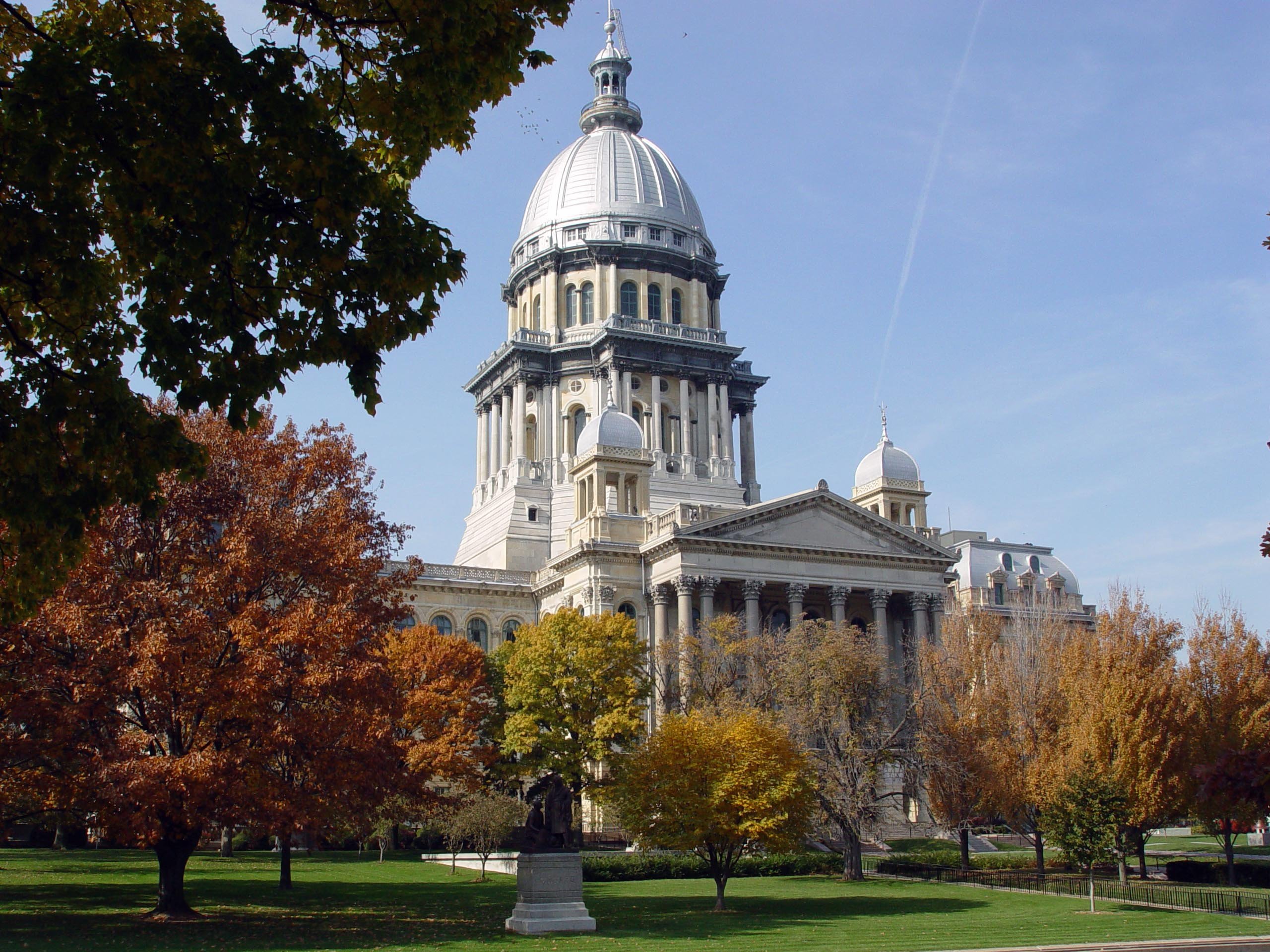
It's a big, beautiful building of the Renaissance Revival style. It's not the prettiest building I've ever seen, but it is the prettiest in Illinois.

I've always, since I was young, had an affinity for public buildings. County courthouses, capitols, old post offices, and finally the massive, timeless, beautifully crafted federal buildings in DC have always captivated me. They have a grandness to them: a sovereign pride that I find riveting. So one of my state's most recent controversies was particularly troubling for me.

A couple years ago the western wing of the Capitol went under reconstruction, mainly to bring it up to fire code, but also to refurbish and replace many of the old materials throughout the wing. The Capitol is well over a century old and, as is the case with many public buildings, doesn't see the sort of regular maintenance you may see in the private sector. Not to say it was ever a hole, but it was due for some improvements. For well over 90% of the renovation things were quiet, with the only people unhappy about the whole project being legislative and executive staffers cast into a nearby state building with an asbestos issue for the duration of the rebuild.

However because of whatever combination of reasons: pension reform, an upcoming election, Bill Daley still pretending to be relevant; it came to WE THE PEOPLE's attention in late August. What specifically came to their attention were these:

The three sets of copper doors installed in the Capitol's west entrance rang up a bill of about $669,000. Outrage ensued. Angry letters, screaming editorials, and unlimited pontificating ensued, whipping the Illinois electorate into a froth. An angry, shouty froth. 'How can we spend so much money on doors and chandeliers when we're cutting our pensions to death' they asked; 'how can you close down an unemployment office and still pay for these doors?' they yelled; 'the economy is in ruin (not really, see Spain), how can we afford these' others complained; or even the classic 'you raised my taxes to build those?! (because you should only pay taxes for services you receive directly, of course).

So what's my problem with all this citizen outrage?

It's not that the funds for the renovation come from a special fund specifically for the Capitol, that has existed for years, and that can't be drawn away from for other ventures (nor can it draw from other funds), or that while $669,000 is a lot to a family of four it's next to nothing for a state of 14 million, or that it doesn't even begin to compare to the amount of money the pension issue entails (mega billions, yo. Warren Buffett couldn't pay down our pension debt), or most importantly that the plan had been approved by both sides, gone completely under the radar, and been in the works prior to the budgetary shit show that now engulfs the state. It's something a little more abstract.

Since the 80's or so Americans have come to the conclusion that government must have a strong 'return on investment' for them, and that if something they pay into doesn't financially profit them, then they shouldn't pay for it. It's the logical conclusion of the 'let's run government like a business' manure proffered by Post-Reagan Republicans.

Sure, government should be fiscally responsible, sure it should manage money responsibly, sure it should be efficient. That said, there's more to governing than turning a profit. The Capitol likely costs each Illinoisan less than $5 annually, and the return we get for that is astounding.

The Illinois Capitol is a cathedral of craftsmanship, awe inspiring, intricate, and beautiful, and when I was young it inspired me. Government should not be housed in cold, gray, featureless mausoleums, but instead in buildings that show what our collective action, as a county, as a state, as a country can build. Public buildings are the physical evidence, plain for all to see, of how much we can make when we all contribute, of what we as a society can build. 

But it's more than that, it's the idea that you, as an Illinoisan, can walk into this building for no reason other than to be there, and that you, in some small way, had a hand in building this, that you have partial ownership to this monument to our republic. When people enter a public building they shouldn't say 'We built this' in anger, their faces contorted in disgust. People should be able to say 'We built this' with pride, with the understanding that it is theirs as much as it is the legislators who reside in it. I recently saw a post on a news blog sum it up a bit more succinctly then I have:

"...attempting to aggrandize self-government is not an entirely contemptible gesture, and in this case it left the people with a museum of vanished craftmanship that dazzles by its sheer exuberance if not its taste. It is unique, priceless, irreplaceable. Almost everyone who sees it with unjaundiced eyes realizes that we could never do that today. Sadder still, we would never dare to try."

Our public works are what they are for a reason. They remind us of our capability when we work together, of the fundamental understanding that we as a society are more than the sum of our individual parts, and that we all do better individually when we do not function only as individuals.They are there to inspire others to the call of service, and to memorialize in history our great gamble to govern ourselves and one another. Are the doors, the chandeliers, and the stained glass that prompted so much ire here at a bad time? Sure. But a century from now they will inspire our children and our grand-children the same as other works inspired us, there's no way to put a price tag on that.




Monday, July 29, 2013

Two Shows Enter, One Show Leaves

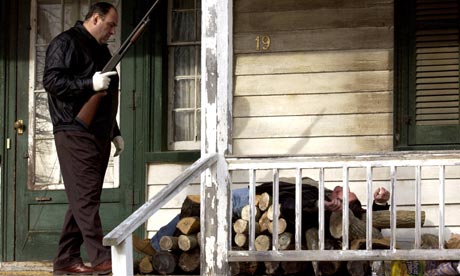
This primate has a gun, so do many of the primates in the shows in question.

Disclaimer: This is a post evaluating two TV series: The Sopranos and The Wire. There will be some spoilers, so bear this in mind going forward.


I'm a person who likes television. A lot. However with that comes some pretty high standards for what I view regularly. You won't find Mike & Molly or Two and a Half Men on my watch list literally ever. I view TV as an incredible story-telling mechanism, with a lot of advantages to offer over film, which has much less time (typically two hours or so) to grow and cultivate characters and explore narratives. Like novels shows have plenty of elbow room to build their universe, perfect their formula, and tell the best story possible.

I find good TV to be immensely enjoyable and a great topic for discussion. Fortunately, so do my friends. So it's commonly asked and talked about as to what exactly is the greatest show ever made, a question to which I have devoted some thought. In my view it comes down between two of the shows I've watched (I have some great shows I still haven't watched though, like Homeland or Deadwood): The Sopranos and The Wire. These two shows, as it turns out, are also the most oft cited shows by critics, though it's hard to say which holds the lead among them. I've watched both in their entirety in the last couple months, and can compare the two with some fresh perspective.

"I'm in the waste management business. Everybody immediately assumes you're mobbed up. It's a stereotype, and it's offensive."

"The fuck did I do?"

It's good to start by saying that the shows have a lot in common, both thematically and in approach. A lot of this probably has to do with HBO (always a safe bet) making both shows, and with the shows being made within a few years of each other. Neither show is prone to hyperbole, and both portray their topic matter quite realistically (The Wire slightly more so), something that mob fiction and police dramas both tend to be quite poor at. Both shows focus on long unwinding story-lines that start quite slow (which can limit their appeal to some) and pick up heat mid-season. They also tend to see their most dramatic events unfold in a season's second to last episode, leaving time for resolution and rejecting the cliff-hangars embraced by many network shows.

Stringer Bell (The Wire): what I would call the most impressive villain in television history.

Carmella Soprano (duh): the strongest, most complex, and most lovingly handled woman I've seen on film.

They are, however, also quite different. The Soprano's is a show very much about characters, featuring a main cast of decent size that is, sparing some deaths over the course of the series, fairly consistent. Because of this laser focus on a handful of individuals The Sopranos is home to what are probably the most richly developed, wonderfully layered characters in the history of television. A character so impressive and complex as Tony Soprano is an extremely rare phenomena, and the show's ability to take young characters like say Meadow and Bobby (who start off the show as young children) and develop them realistically into multi-dimensional adults is quite impressive, especially given the tendency of other shows to waste child characters (Walking Dead, anyone?). Character arcs as long and winding as Christopher Molisanti's are also uncommon, and the unceremonious way in which it is cut off makes it all the more impressive, helping drive home the sense that characters are not larger than life, but simply mortals like the rest of us. The Sopranos also has the unusual quality (not shared by The Wire) of following a protagonist who is consistently sympathetic yet very much a villain. The show occasionally reminds the viewer of this in sudden (Pie-Oh-My; Cold Cuts) and disturbing ways, yet all the while manages to keep you attempting to deny the ugly truth about Tony's sociopathy. It took me til season six to accept that truth about Tony, despite its being stated outright several times throughout the show, a fairly impressive feat.


Bodie Broadus (above, The Wire) and Christopher Moltisanti (below, The Sopranos): the characters from each show displaying the most impressive character arcs and most matured development.

The Wire is, as is commonly noted, a show primarily about institutions. Specifically the way institutions; be they schools, police forces, gangs, or unions; shape the individuals that pass through them. Honest men with good intentions like Frank Sabotka (praise his name) are bent into corrupt serial lawbreakers by forces larger than them while scheming, violent criminals like Stringer Bell come to try and escape 'the game' altogether due to some of the very same factors. While the show has a much more sprawling cast than The Sopranos, it still manages to develop impressive characters that are, unlike The Sopranos, much more diverse in their backgrounds. Bubbles, Jimmy McNulty, Ziggy Sobotka, and Avon Barksdale have next to nothing in common in their backgrounds, roles, or ambitions; a seemingly scatterbrained set up. However this diversity in cast is one of the show's greatest strengths, bringing extremely varied perspectives to the narrative, making the story that much more immersive. The Sopranos' major characters almost universally hail from the mob or their members' immediate families (though Dr. Melfi is a notable exception), a place where it loses some ground to The Wire. Characters like Omar Little make things even more interesting, making it impossible for the viewer to not root for them (how could you not in his court appearance in All Prologue), yet as Bunk Moreland points out in Homecoming Omar is as much a part of the problem as lawyer Maurice Levy or the also lovable Proposition Joe.

Frank Sabotka (The Wire): Never have I seen a more tragic story unfold on television, not just for Frank, but for what he represents as well.

Vito Spatafore (The Sopranos): A fine runner-up to the above and the toughest story to live down in The Sopranos.

At the end of the day though, it's The Wire, and it's not too close either. I spent the last paragraph on The Wire's characters and its continual analysis of the institutions that shape them, but that's only scratching the surface. A similar amount of space could be devoted to its hybrid open love letter/stinging rebuke of the city of Baltimore. Or the shows literary approach to story telling, reflecting David Simon's background as a writer. There are two defining aspects, however, that put the show over for me. The first is the decision in Season 4 to take four virtually untainted young men and follow them through the coming of age period as the forces around them: Stanfield's drug empire, the underfunded-stat obsessed school system, and the similarly diseased police department guide them along to extremely different outcomes. Taking four 'blank slate' characters and showing how differently they turn out helps illustrate the vicious cycle Simon seeks to explore and the forces at play in the show. The second is the shows' 'generational' view of the people in the institutions featured, giving the show a beautiful symmetry. Michael Lee takes on Omar Little's role, Ellis Carver for Cedric Daniels, or Rhonda Pearlman for Judge Daniel Phelan. These are just a few, by the end of Season 5 literally a dozen can be found.  It advocates the idea that since the institutions profiled are largely unchanged over the show, too large to be altered by any one character, they create similar outcomes for the people in them over time. Thus some characters come to resemble others, sort of picking up the baton as the older generation leaves the scene. It also gives a sort of eternal sense to the show: even though Jimmy McNulty may have seen his last days as real po-lice, Kima Greggs and Leander Sydnor are quickly taking his place. It helps take the sting out of some of the shows rougher events.

Omar Little (The Wire): Fan favorite, and of the more absurd (though believable) and complex characters in the show.

Adriana La Cerva (The Sopranos): A staple of the show who is central to perhaps the series' most memorable episode.

The Sopranos also trips up in a couple ways that put it behind for me. Much like one of HBO's previous shows, Oz, The Sopranos has a tendency to feign character development, though by no means to the extent that Oz does. Christopher's repeated relapses into drugs and alcohol, Tony's slow decent back into infidelity post Whitecaps (perhaps the most disappointing for me), or Janice's failed attempts to reign in her anger issues (a story-line completely left by the wayside after one shortcoming) all exemplify this tendency, to varying extents (Matthew Weiner, a major force in the show, seems to have similar issues in Mad Men). The changes seen in characters like Bodie Broadus or Malik 'Poot' Carr over the course of The Wire have much more permanence to them, an aspect I appreciate. Additionally where The Wire is constantly subtle, paced, and understated (yet poignant), The Sopranos does have the occasional tendency to be heavy handed in its story-telling. What comes to my mind are the frequent dream sequences (which aren't all fully explored) that occur throughout the series, or Tony's occasional hallucinations. While some are quite good they seem a bit of a clumsy way to tell the story, and sometimes disrupt the flow all together. Finally the complete and total incompetence with which the FBI operates in the show, and the impunity that dozens of murders are committed with, drag the show down slightly. While the show is about the mob and should focus on that rather than the police it still seems odd that the federal government, which rather than other mobs is the primary threat to organized crime today, is barely ever seen as more than a passing threat. Over six seasons the agency barely ever gets more than a foothold in Soprano's organization despite somehow (the how of which is scantly detailed) bringing RICO charges against Johnny Sac and Junior Soprano.


Ellis Carver (above, The Wire) and Silvio 'Sil' Dante (below, The Sopranos): My personal favorites from each show.

Make no mistake, The Sopranos is an incredible show that while not making the #1 spot easily captures #2. Similarly, The Wire is not perfect itself: its jargon littered episodes and crawling narratives make it a hard sell to most and takes a couple complete viewings to fully come together. However to me it's the superior show, primarily on account of its macro-focus on society and institutions as opposed to individuals. That could just be my background in large-scope issues, as a political science major, coming into play; but it's certainly a big part of what puts it over the edge for me.

To celebrate my favorite show I picked 'Way Down in the Hole' to top off the post, the Tom Waits version specifically, which is probably my favorite of the five. It fits the show more than most of the others and paired in an unforgettable way with the oft-neglected Season 2 (which was one of my favorites).